

Working as a tutor since age 14, GW Engineering junior Ijeoma Monu began her lesson as she always had, explaining concepts in what she thought was clear language. However, when it became apparent that her student still wasn’t picking it up, Monu quickly switched tactics to a visual format. Suddenly, his eyes lit up.
“It’s so interesting to see how the mind works,” Monu reflected. “Something I thought I was communicating clearly just wasn’t understood. But just by changing the perspective, making it visual, it flipped that switch in his mind and helped him grasp onto the topic.”
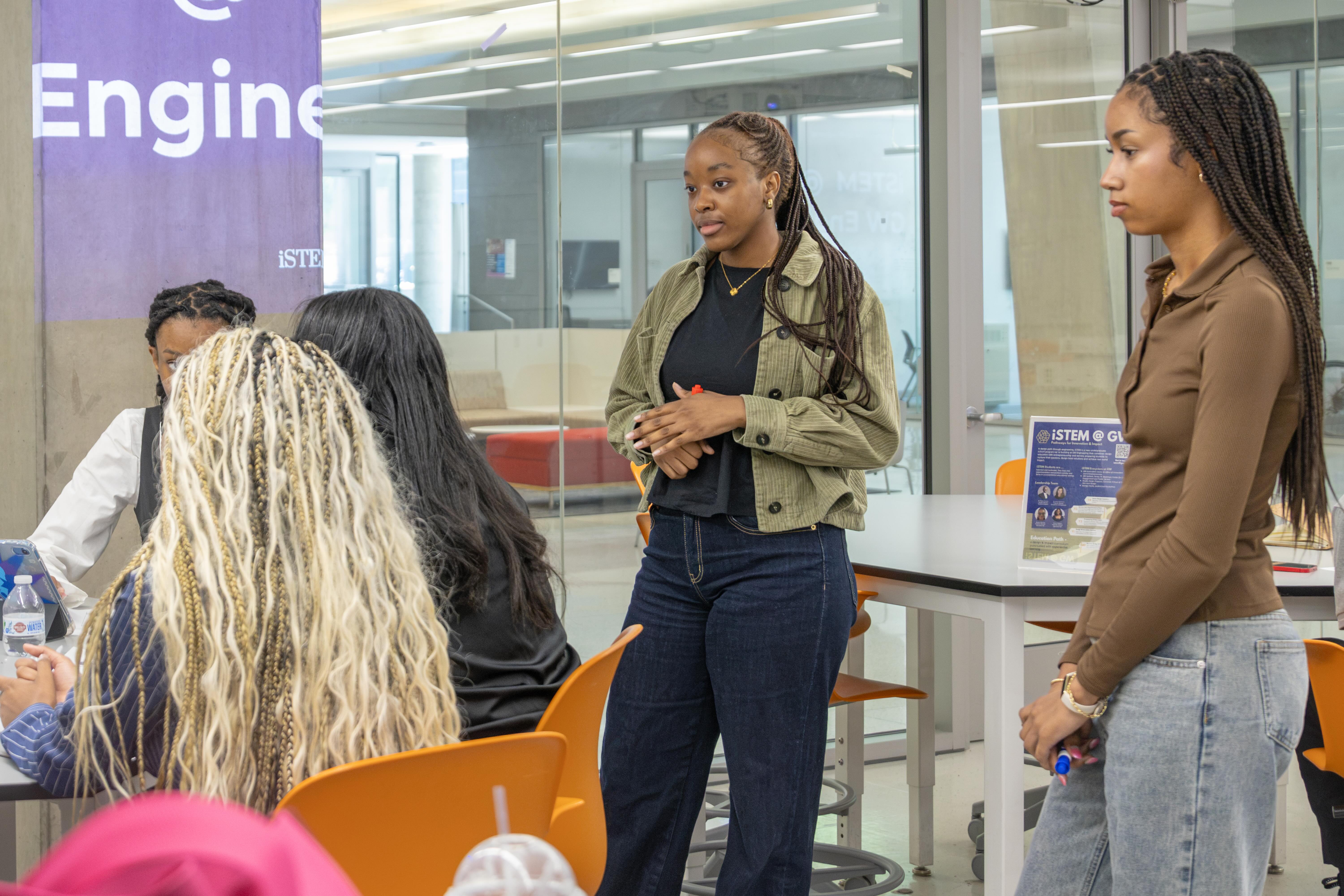
Monu was also one of these students who, when growing up, needed the personalized learning she wasn’t getting in school. Now, as a member in the inaugural cohort of GW Engineering’s new undergraduate program, iSTEM@GW, she is advancing an accessible online learning platform that will offer lessons tailored to the learning styles of students like her.
An unconventional learner himself, inventor, entrepreneur, and distinguished alumnus Emilio A. Fernandez, Jr., M.E.A. ‘76, funded the creation of iSTEM programs at leading universities in the U.S. iSTEM@GW, launched in fall 2025, follows the inaugural iSTEM program established at Stevens Institute of Technology in 2019. The network continues to grow as programs are also being developed at the University of Maryland, College Park, and the Rochester Institute of Technology.
Fernandez’s vision for iSTEM is to unlock the overlooked potential of unconventional students who may not have had access to advanced coursework in science, technology, engineering, and mathematics (STEM). iSTEM@GW connects engineering with design, community engagement, and entrepreneurship through hands-on, project-based learning experiences to help them contribute their big ideas to society.
“We believe that engineering can be seen at the intersection of everything that shapes and moves the world forward,” said GW Engineering Dean John Lach. “iSTEM@GW is a unique embodiment of this 'engineering and…’ ethos, which drives us to create interdisciplinary experiences for GW Engineering students. We are very excited to add this program to our offerings to revolutionize how unconventional thinkers and innovative students see themselves as future engineering leaders through a blend of technical rigor and creative entrepreneurship.”
Solving Real-World Problems for Community Impact
Design in engineering is the iterative process of developing a solution to a problem. While engineering students are asked to design products and prototypes in class, Dr. Erica Wortham, Program Director of iSTEM@GW, notes that “there is little emphasis on design as a discipline.” Wortham also serves as Director of GW’s Innovation Center and Director of Co-Curricular Engagement and Interdisciplinary Programs at GW Engineering.
In partnership with GW’s Corcoran School of the Arts and Design, the program offers courses to teach iSTEM students design fundamentals and how to incorporate them into their projects from day one. Each structure and system in the built environment is designed, so by emphasizing the “why” behind them, Wortham notes that this interdisciplinary curriculum will enhance their critical thinking and open-ended problem-solving skills.
“A lot of times, engineers are taught that design is about following instructions that the client gives you, like we need this and we need you to make it with that,” Wortham said. “That’s still important, but what about thinking bigger?”
iSTEM@GW aims to attract students inspired to leverage the creative potential of engineering, such as those in the inaugural cohort, including Monu, junior Amel Alahmadi, recent graduate Benyat Yimaj, B.S. ‘26, and sophomore Sydney Tannenbaum. They were each headed elsewhere when they chose to pursue engineering and were drawn to iSTEM by the opportunity to think bigger and use their technical skills to design solutions for real-world problems.
“Through iSTEM, I can use my engineering lens and design lens to figure out a solution to any problem,” Alahmadi shared.
Her journey is echoed by her peers, each of whom leveraged iSTEM’s resources to pursue projects with personal and community significance. Selecting a project with community significance is a core part of iSTEM@GW, designed to deepen GW Engineering’s connection to Washington, D.C. and the surrounding community.
“We need to have an impact, and our students need to see how engineering can change our communities for better and for worse. Most students hear more about the impact from an economic, industrial, and technological perspective, but not as much from a community impact and legacy perspective,” said Royce Francis, faculty director of iSTEM@GW and associate professor of engineering management and systems engineering.
Alahmadi and Yimaj are both tackling textile waste in the greater D.C. area in their projects. The connections Alahmadi is making across the district through iSTEM campus partner, GW’s Honey W. Nashman Center for Civic Engagement and Public Service, help her identify new opportunities for clothing reuse. Meanwhile, Yimaj’s venture, Park Avenue Clothing Exchange (P.A.C.E.), began nearly 2 years ago in Falls Church, Virginia.
Last fall, Yimaj began to feel a lack of ownership because P.A.C.E. had veered away from its original purpose of providing access to affordable, quality clothes and toward a profit focus. He recalled that joining iSTEM “felt like the last piece of the puzzle,” as its emphasis on human-centered design and input from peers helped him reconnect with the ‘why?’
“Re-evaluating stakeholders helped me refocus on the people and groups I should be looking to impact on a small scale, and then what that impact could look like when scaled up,” he said.
Preparing Future Changemakers
iSTEM@GW is an outlier among typical engineering curricula, where group projects are more common, because it allows students an opportunity to take sole ownership of a project. Although designed for first-year students, Yimaj’s iSTEM@GW experience exemplifies how projects can naturally evolve and deepen over time, while Monu’s demonstrates that even with an existing idea, it can be hard to envision a clear starting point for making it a reality.
“Through our meetings, conversations, and homework assignments–which didn’t even really feel like homework because it was led by me and that I had been driven to do it–iSTEM made everything feel so much more obtainable,” Monu stated.
This is the “push” that Francis feels iSTEM programming provides for GW Engineering students. “It helps prompt creative thinking by introducing them to a range of concepts and ideas that they may not have had before they started thinking about their ideas. These concepts could serve as a toolkit that has the potential to enrich their thinking about their projects and impact,” he said.

The incoming cohort will enroll in the Project Incubator course offered each semester, providing dedicated time from day one to develop their ideas and iterate on challenges and opportunities throughout their academic careers. Dedicated faculty mentors, leadership development opportunities, industry exposure events, and additional campus partnerships with GW’s Office of Innovation & Entrepreneurship will further support students, helping them persist in their education and empowering them to see themselves as changemakers and future entrepreneurs.
"With support from faculty mentors and the Project Incubator at every stage, students gain the guidance and resources needed to move their ideas from concept to implementation and turn ambitious goals into real-world impact,” said Brooke Duncan, assistant director of iSTEM@GW.
As iSTEM’s home base, the GW Innovation Center offers students an unstructured environment where they can work with their hands and try out ideas without negative consequences. Wortham encourages them to keep the openness and curiosity that drew them to apply to iSTEM in the first place.
“Dr. Wortham advises us to always think big and never think a problem is too big for us to tackle. She reiterated that just because a problem may be nationwide or worldwide, if you can fix that problem within your community, then you already have gold on your hands,” Yimaj said.