

Artificial intelligence (AI) systems are more widely available than ever and are rapidly changing how we work and live. Many of us are just a click away from large language models (LLMs) like ChatGPT and Gemini that can generate, understand, analyze, and translate text in just seconds.
These systems present challenges and opportunities – on one hand, they can be intimidating and challenging to understand and use. On the other hand, they can be empowering tools that create new opportunities to advance discovery, education, and innovation.
These tools have transformed higher education, where faculty and students alike have access to knowledge like never before. It’s not enough to simply have access, though, and faculty and students must be prepared to capitalize on these opportunities and apply AI technologies to their workflows in a responsible manner.
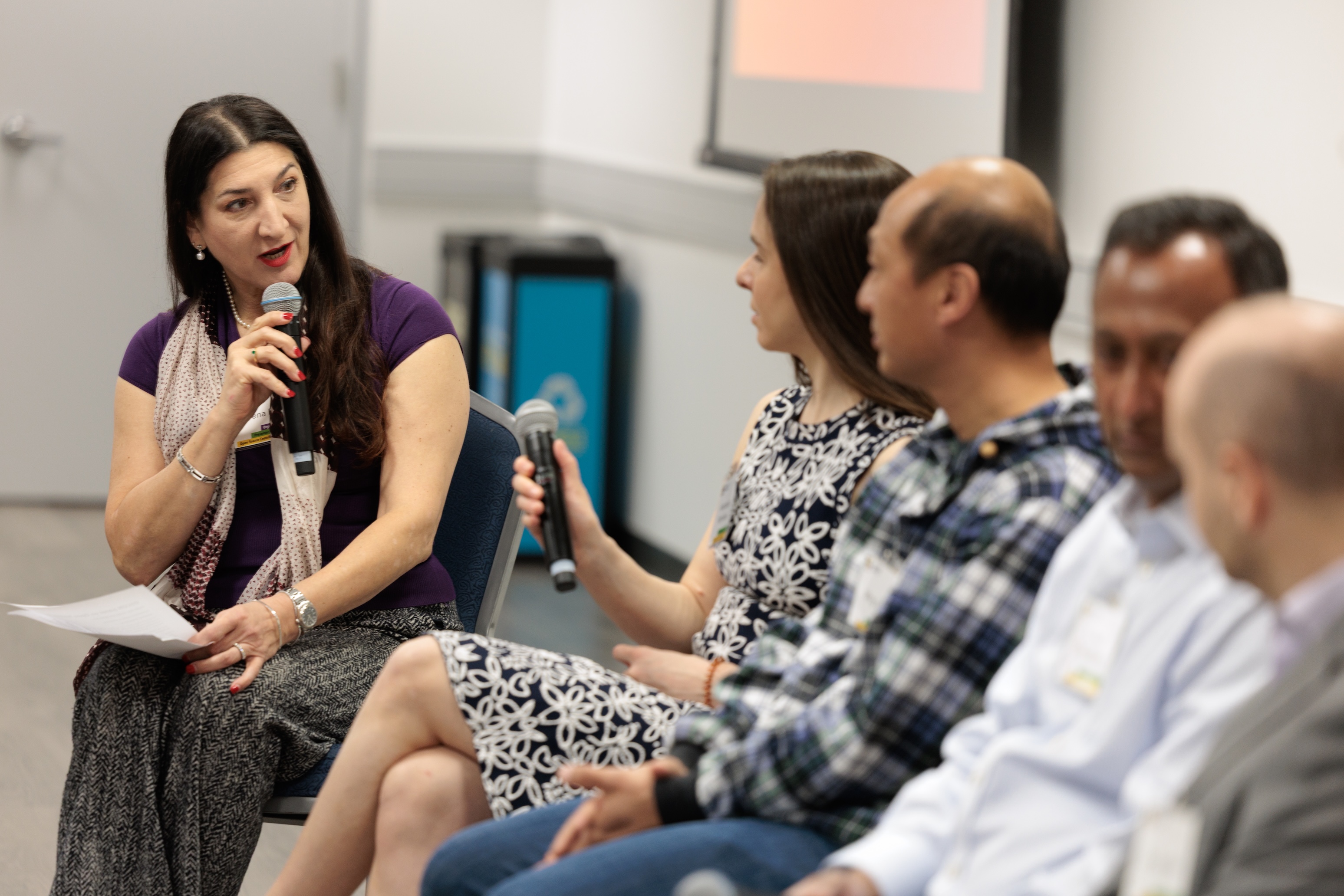
GW Engineering Professor Lorena A. Barba has launched the GW Engineering AI Academy to support faculty in developing AI capabilities that can be applied directly to their teaching and research, giving them confidence, fluency, and excitement about the future with AI. The initiative is part of the school’s partnership with the Kern Entrepreneurial Engineering Network (KEEN).
“We were talking with Interim Dean Jason Zara about the need for AI literacy among faculty, and the idea came up of combining workshops with looking into a portion of their course, like an assessment or a project, for AI capabilities,” Barba said.
“Implementing or proposing a redesign, then presenting to the rest of the faculty, we imagined could motivate broader discussions—we used the word “capstone,” and in an instant the notion of an internal certification, an internal academy, took shape,” she concluded.
The academy is designed to promote AI literacy through the lens of the entrepreneurial mindset, a framework championed by KEEN as a “set of attitudes, habits, and behaviors conducive to problem-solving, innovation, and value creation, especially in engineering contexts.”
The entrepreneurial mindset is built on three core principles: curiosity, connections, and creating value. In the context of AI, these principles translate to exploring what we can do with AI, building deep, practical workflows, and applying AI for student success.
“We are thrilled to partner with KEEN on this program. GW has had a strong and fruitful partnership with KEEN since 2018, and I couldn’t imagine a better partnership to empower our faculty and students to be the next generation of AI innovators and entrepreneurs,” said Jason Zara, GW Engineering’s Interim Dean.
The AI Academy launched in November 2025 with a cohort of fifteen members from across all six GW Engineering departments. The goal is for each cohort to mentor the next generation of faculty, building AI fluency and community across the school.
Academy participants attend biweekly structured lessons to develop their skills and bimonthly intensive workshops focused on providing hands-on applications of the material.
The curriculum is comprehensive, providing faculty with a breadth of knowledge over their six-month tenure, covering foundational competencies in AI and prompt engineering, as well as how to build their own AI chatbots, enhance research productivity, and redesign evaluation methods for AI-capable students.
“The curriculum moves from individual apps to integrated workflows because that's where the real productivity gains are. And we chose the Entrepreneurial Mindset as our lens because curiosity, connections, and creating value are precisely the human skills that AI amplifies rather than replaces,” Barba explained.
The academy emphasizes not only building AI capabilities but also ensuring ethical and trustworthy applications of said capabilities. It strives to build leaders in applied AI who can, in turn, empower their students and fellow faculty to lead responsible AI adoption and drive institutional policy.
“The AI Academy represents a huge step forward for our school, solidifying GW Engineering as an AI-forward institution. The Academy will help keep our faculty ahead of the AI curve, and in turn, empower our students,” said Interim Dean Zara.
One cohort member, Professor Eric Dano from the Department of Engineering Management and Systems Engineering, has already gained confidence and skills in the two months since starting the program. "Participation in the AI Academy has been a deeply valuable experience for me,” Dano said.
“Beyond providing a collaborative forum for engaging with fellow faculty on the integration of AI into the classroom, the Academy equipped me with practical AI tools that directly enhance both my teaching and research,” he shared.
Dano explained that his experiences with the Academy have underscored that today’s engineering students are entering a professional environment where well-honed AI skills are essential.
“By intentionally integrating AI into engineering curricula, we can better prepare students to accelerate system development, reduce human error, and succeed in an increasingly AI-enabled engineering workforce,” he concluded.