

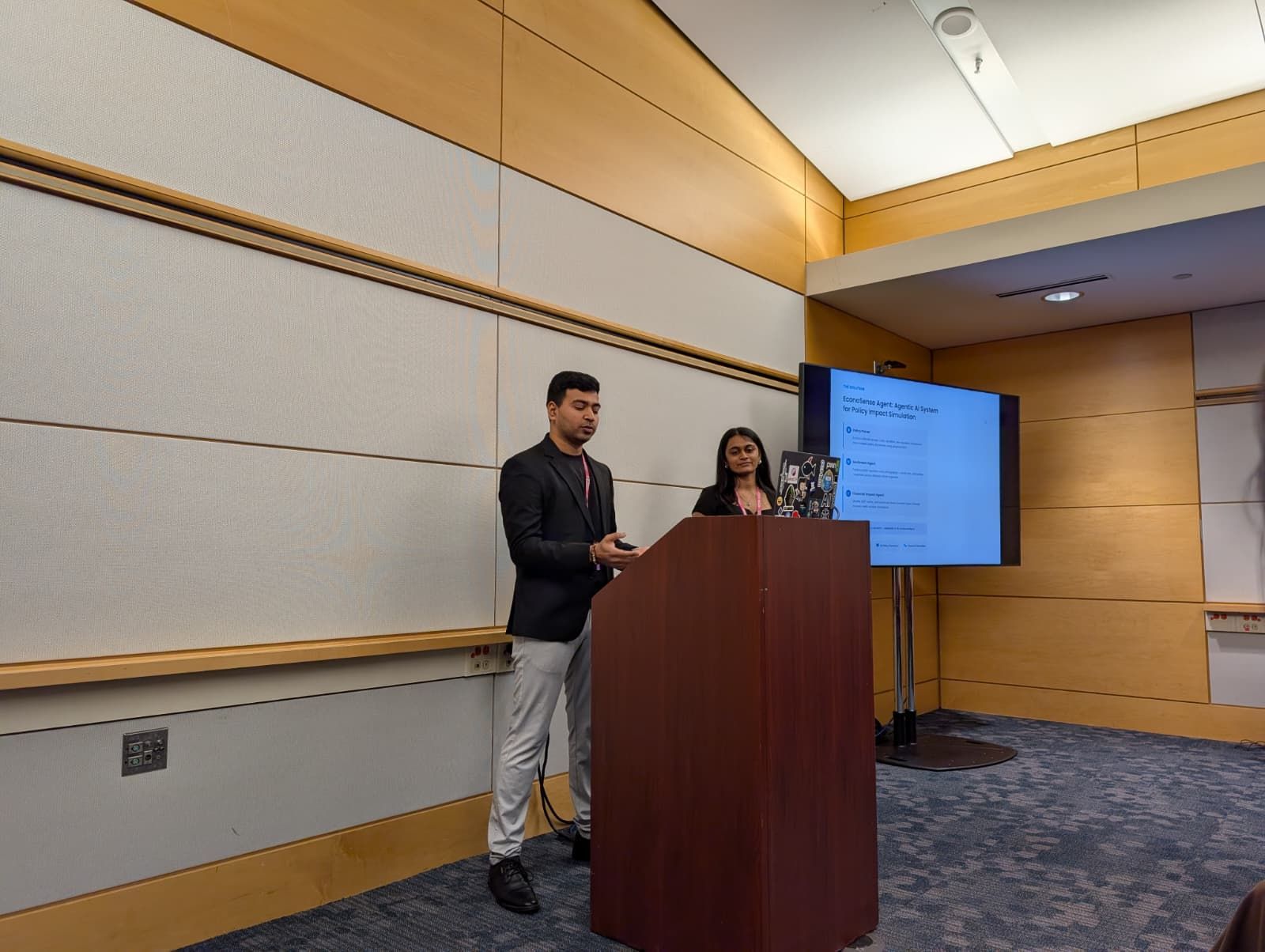
Imagine you’re a policymaker considering a new carbon tax policy on fossil fuel companies. Before passing a law, it’s crucial to identify who may or may not agree with the policy and why. This is where Ecosense comes in–a tool to help policymakers predict reactions and craft smarter, more inclusive policies.
Shrey Patel, a master’s student in cybersecurity, and Ritu Patel, a master’s student in data science, co-developed Ecosense during the Agentic AI Hackathon at DevFest DC 2025, an annual community-led software engineering conference. The duo won the hackathon’s Most Innovative Award and were invited to pitch their idea at DC Startup & Tech Week 2025.
Agentic AI refers to advanced artificial intelligence systems that act independently, using reasoning, planning, and goal-oriented decision-making to solve problems in real-time.
In the carbon tax example, Ecosense would immediately suggest data-backed actions to minimize opposition, such as subsidies or phased rollouts, thereby reducing the time decision-makers spend researching the public and economic impact of proposed laws.
“Our goal was to see how Agentic AI could make this process faster, cheaper, and more transparent, helping governments analyze sentiment, affected industries, and alternatives within seconds,” Shrey Patel said.
Shrey leveraged his background in agentic systems and multi-stakeholder impact modeling, while Ritu applied her knowledge in data science to co-develop Ecosense. The award at DevFest DC marks their second win in less than a year–last spring, the team’s chatbot assistant for farmers won first place in the Health and Environment Track at the Innovation Hackathon hosted by George Hacks.
“It wasn’t just about technical skills–it was about creative synergy. Ritu focused on the data analysis pipeline, while I handled the AI model architecture and system design that powered Ecosense’s automation,” said Shrey Patel.
Together, they merged governance and finance into one cohesive, AI-driven solution. Judges were impressed with how Ecosense addresses real challenges, such as government shutdowns and communication gaps in public policy, while delivering real-time, data-backed insights.
At DC Tech and Startup Week, the team received another great vote of confidence in their solution from the founders, entrepreneurs, investors, and fellow innovators who attended the four-day event. They were encouraged to validate Ecosense with real policy data, with one attendee even offering to support early marketing efforts.
“This was our first time pitching a GovTech solution to both technical and non-technical, which helped us refine how we communicate AI’s impact in simple terms,” Shrey Patel stated.
To further refine Ecosense, the team plans to expand data coverage, enhance model accuracy, and explore collaborations with government agencies, NGOs, and research institutions. Their goal is to scale Ecosense into a platform for data-driven policy simulation and forecasting.
What started as a hackathon project is now a budding venture that will have a real-world impact by making policymaking more transparent, evidence-based, and citizen-focused.